

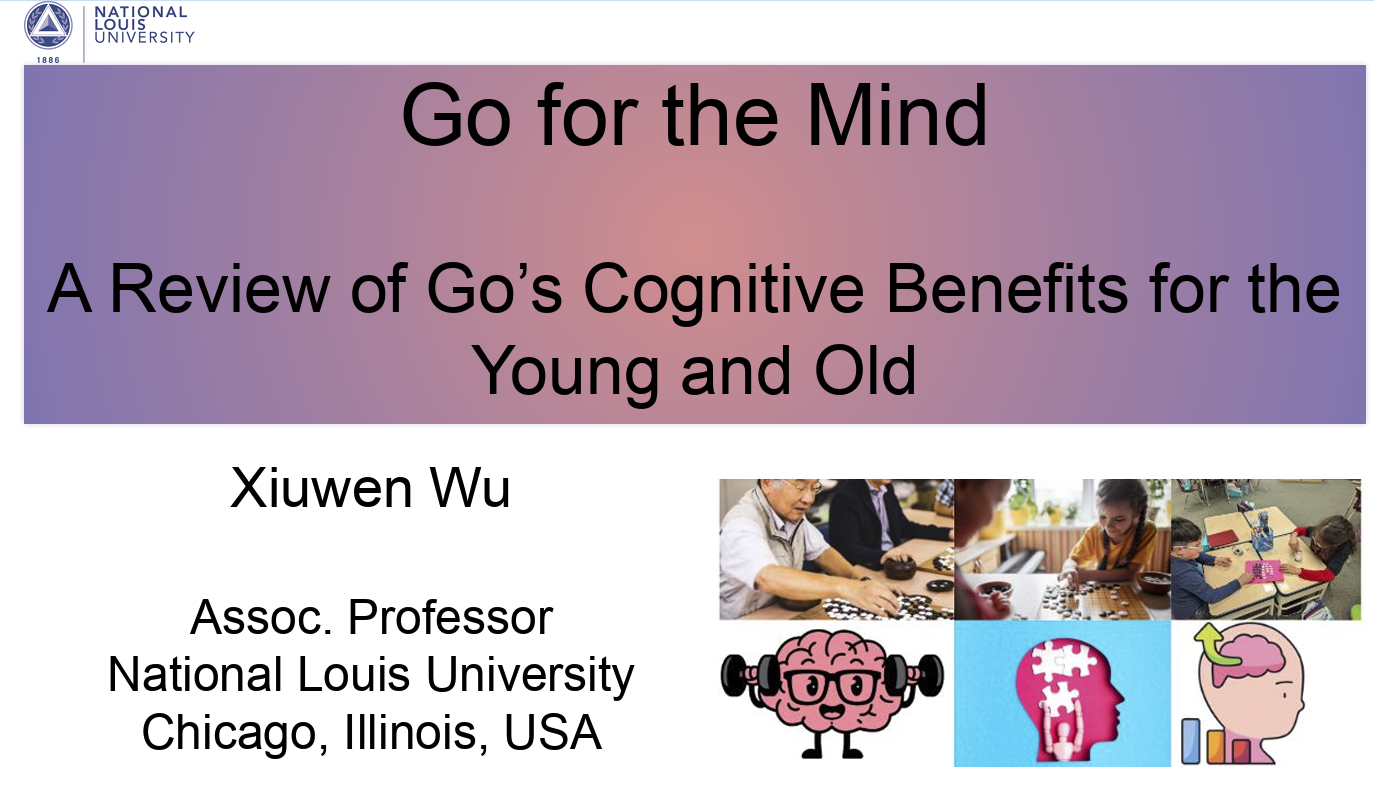
The first university research project sponsored by INAF is bearing fruit. The work by Professor Xiuwen Wu was presented at the third annual conference of the International Society of Go Studies (ISGS) held on July 23, 2025, held in parallel with the European Go Congress in Warsaw, Poland.
Professor Wu is an associate professor in the Special Education Program at the National College of Education, National Louis University. Her research focuses on visual literacy, educational technology, and co-teaching. In her report, titled “Go for the Mind: A Review of Go’s Cognitive Benefits for the Young and Old”, Professor Wu gave a comprehensive review of published literature on the relationship between Go, the mind sport, and cognitive science. The work may be viewed <here>, in addition to publication in the ISGS Journal.
Abstract:
This systematic review examines the cognitive benefits of playing the board game Go, focusing on its impact on cognitive development in children and cognitive function in older adults. The review synthesized 13 peer-reviewed studies published between 2000 and 2024 from Asia, Europe, and North America. The studies explored the relationship between Go and cognition in children and older adults with and without cognitive decline.
The review found promising evidence that playing Go can support cognitive growth in both age groups. In older adults, especially those with mild cognitive impairment, Go was associated with improvements in specific cognitive domains, reduced depressive symptoms, and a higher quality of life. Neuroimaging studies showed increased brain activation in areas related to attention and memory, and biomarker analyses suggested enhanced brain health.
For children, particularly those with Attention Deficit/Hyperactivity Disorder (ADHD), Go was linked to improved attention regulation, working memory, and executive function. The game’s strategic and visual-spatial features also supported mathematical reasoning, problem-solving, and logical explanation.
While research on Go’s cognitive benefits is emerging, most existing studies have focused on older adults, with less research on children or classroom settings. Limitations include small sample sizes, inconsistent study durations, and limited effect size reporting, which constrain the generalizability of the findings. The review concludes that Go is a promising, low-cost tool that can support cognitive and academic development in children, act as a complementary intervention for children with ADHD, and enhance cognitive function in older adults. Future research is needed, especially in early education and school curricula, to fully explore Go’s developmental and therapeutic potential.